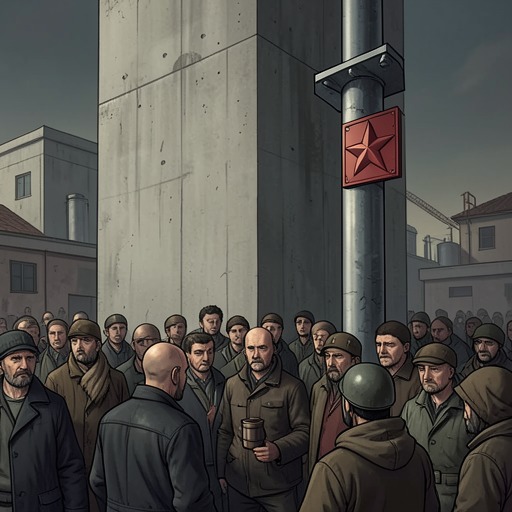
Soviet ideological orthodoxy
Doctor ZhivagoThe Soviet demand for ideological orthodoxy is presented as a rule that reaches beyond public politics into professional work, intellectual inquiry, and private security. Yurii’s account to Lara shows how permission to work and offer ideas narrows into an expectation that ideas serve as praise for the revolution and regime. What begins as a promise of openness ends in self-censorship, threatened dismissal, and fear of arrest.
The promise and its limits
Yurii explains that he may have to resign from his jobs after encountering the same pattern repeatedly: at first, institutions welcome honest work, struggle, and new ideas; in practice, the acceptable ideas prove to be little more than words in praise of the revolution and regime. The distinction is decisive. Work itself is not rejected, but its value is made conditional on the political language attached to it. Yurii is weary of being required to perform that language, and says it is not something he is good at.
He does not describe the officials’ position as inexplicable. From their point of view, he concedes, their judgment may seem justified, and he acknowledges that he is not on their side. His objection is to the moral division their framework imposes: its adherents appear as radiant heroes, while dissenters like him are cast as mean supporters of tyranny and obscurantism. Ideological conformity thus claims not only to determine which opinions are acceptable but also to dictate the moral identities assigned to those who refuse them.
Intellectual inquiry treated as deviation
The conversation turns to Nikolai Vedeniapin, whose influence Yurii says is counted against him. Lara knows of Vedeniapin through what Yurii has told her and through Sima Tuntseva, who follows his ideas, although she has not read his books. Yurii’s intellectual inheritance is consequently part of the dispute: an association with independent thought can itself be classified as evidence of corruption.
The specific ideas at issue are not political slogans but ways of understanding life. Yurii says that one of his supposed sins is believing in intuition, even though others praise him as a remarkable diagnostician and he believes he rarely misdiagnoses disease. He asks what an immediate grasp of a situation as a whole could be, if not the intuition condemned by his critics. The contradiction exposes the practical incoherence of the orthodoxy: a faculty valued when it produces medical success becomes suspect when named as an idea.
His other example is mimicry, the outward adaptation of an organism to the color of its environment. Yurii is interested in whether this biological phenomenon can illuminate the relation between the inward and outward worlds. When he touches on the subject in lectures, his listeners answer with a chorus of labels—“Idealism, mysticism, Goethe's Naturphilosophie, neo-Schellingism.” The labels replace engagement with the question. A proposed inquiry into the relation of organism and environment is made legible as forbidden doctrine before it can be considered on its own terms.
Work, withdrawal, and fear
Yurii’s response is not an immediate abandonment of every position. He intends to remain at the hospital until he is forced out, but plans to resign from the Institute and the Health Service. This distinction shows how the rule operates through professional institutions and how he tries to preserve some space for his work while withdrawing from places where conformity has become intolerable. He also admits that he sometimes feels he may be arrested at any moment. The conflict has moved beyond irritation with official rhetoric: intellectual independence now carries the possibility of physical coercion.
Lara recognizes the danger and describes a recurring progression in the regime’s conduct. Its first stage presents itself as the triumph of reason, criticism, and the struggle against prejudice; the second turns toward suspicion of supposed sympathizers and hangers-on, bringing informers, intrigues, and hatreds. Her account gives the pressure a political rhythm: the language of liberation and reason does not guarantee continuing openness, and can be followed by a climate in which people are assessed for hidden loyalties.
From orthodoxy to danger at home
Lara points to local evidence rather than treating the danger as abstract. Two former political convicts from among the workers, Tiverzin and Antipov, have recently been transferred from Khodatskoie to the local evolutionary court. Both know her well; one is her father-in-law. Yet Lara says that their arrival has only recently made her truly fear for her life and Katenka’s. She believes Antipov dislikes Yurii and that the men might destroy Yurii and even Pasha in the name of higher revolutionary justice. The language of justice therefore appears as a possible warrant for violence, while personal acquaintance offers no protection.
Events soon reinforce her alarm. A nighttime search at the widow Goregliadova’s house at 48 Buianovka Street, next to the hospital, uncovers a cache of arms and an alleged counterrevolutionary organization. Arrests follow, and searches continue in a widening wave. The incident is not proof that every feared arrest will occur, but it gives the fear a concrete setting and consequence: police action reaches the neighborhood around Yurii’s workplace, and people disappear into the accumulating investigations.
Rumors that some suspects escaped across the river provoke an exchange that makes escape sound almost hopeless. People point to the Amur at Blagoveshchensk, where crossing the river would mean reaching China, and distinguish that immense boundary from the local river. The joke turns geography into a measure of desperation: flight is imagined as possible only across a river on an entirely different scale, while the immediate surroundings fill with threats.
Lara concludes that their time of safety is over and expects that she and Yurii will be arrested. Her fear is inseparable from her responsibility for Katenka: as a mother, she cannot allow the child to be caught in the disaster, and she needs a plan. The demand for ideological orthodoxy has thus reached its most intimate consequence. It does not merely silence ideas or threaten careers; it makes a mother calculate how to protect a child as public suspicion closes around the family.